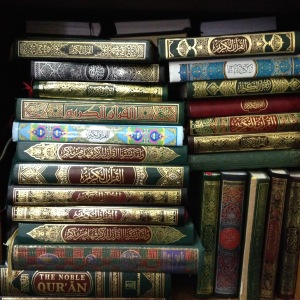
I have two days left to read these books


Max Havelaar, or The Coffee Auctions of the Dutch Trading Company, Multatuli, 1860
Fact was, there was my mother’s skin. She was fair, that’s true, but her skin had a tawny hue, very much like the color of the lansat fruit, held up as the model for the perfect “native” complexion. That was offered as one proof that Mama wasn’t pure-blooded Dutch. The color of real Dutch people is different, a splotchy red color like that of a piglet. So, actually, the comments of my friends from the garrison made me feel proud. Who wanted to be Dutch anyway when the life of a native army brat was a million times more interesting? Who wanted to be a Dutch boy, forced to dress so very neatly with a spanking white shirt and shoes and who had to remember hundreds of little points of politeness which made you end up feeling no better than a marmot in a cage?
-Y.B. Mangunwijaya, The Weaverbirds, 1981
Jazz, Perfume, and the Incident, Seno Gumira Ajidarma, 1996

Funu: The Unfinished Saga of East Timor, Jose Ramos-Horta, 1987
The Crossing, Luis Cardoso, 1997
Beloved Land: Stories, Struggles, and Secrets from Timor-Leste, Gordon Peake, 2013

Java in the 14th Century, translated and edited by Theodore G. Th. Pigeaud, 1960
The Desawarnana of Mpu Prapañca, translated and edited by S.O. Robson, 1995
When I was nine I was not a virgin. People didn’t consider a girl who didn’t yet have breasts to be a virgin. But there was something I was keeping secret from my parents:
When they got wind of the fact that I was secretly meeting an ogre, my mother revealed a big secret: that I was actually made of porcelain. Statues, plates and cups made from porcelain come in hues of blue, light green, even brown. But they mustn’t be allowed to crack, because if they do they will be thrown on to the rubbish dump or used as tombstone ornaments. My mother said I would never crack as long as I kept my virginity. I was taken aback: how could I preserve something I didn’t yet have?
Continue reading
I admit, I have not been here long. But I trust that the question asked one day will be what I did, and whether I did it well, not whether I did it in too short a time. To me, any time is too long when it is marked by extortion and oppression, and on me every second would weigh heavy which, owing to my negligence, my dereliction of duty, my ‘spirit of compromise,’ had been spent in misery by others.
Multatuli, Max Havelaar, or the Coffee
Auctions of a Dutch Trading Company
Blossoms of Longing: Ancient Verses of Love and Lament, translated from the Old Javanese by Thomas M. Hunter, 1998
Hi there. It’s been about a month since my last blog post; I’ve been doing a bit of traveling and also busy applying for a job that I really want, so the blog has taken a bit of a backseat. I’m still reading though! I’m currently spending a month in Ireland, attending three different weddings and giving the baby a chance to spend some with her grandparents and aunt over here. Before I left I tried frantically to read all the East Timor books I’d taken out from the library (with limited success–I got through The Crossing but Beloved Land and Funu proved too much for me). I returned them all with a sigh of relief last weekend, and headed off to Ireland with a bunch of the lovely Indonesian books that my in-laws bought me for Christmas. As much as I love the library, and as great as it’s been being able to source some truly obscure books that would have cost me a fortune to buy, it’s a relief to know that my current batch of novels don’t have an expiration date! I’m currently reading Desawarnana (which I did take out from the library and failed to finish before departure, but I photocopied the last few pages so I could finish them at my leisure), Blossoms of Longing (which is only available to read online via the Lontar foundation, so reading that on my computer when I have an internet connection), Max Havelaar (an actual book! that I own and can make notes in! yay!) and Sitti Nurbaya: A Love Unrealized (on kindle)–and enjoying them very much.


 Around the World in 2000 Books