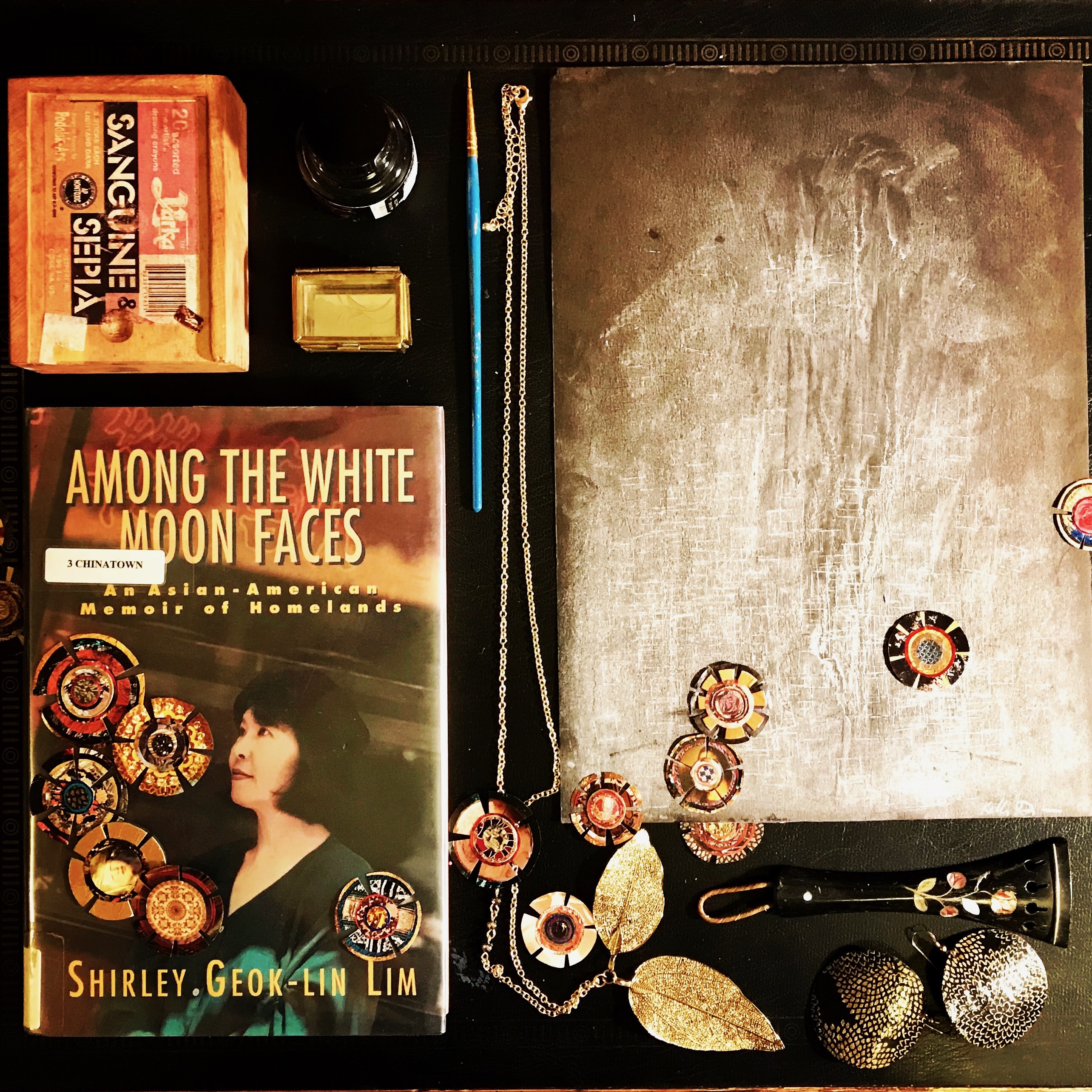
Among the White Moon Faces: An Asian-American Memoir of Homelands, Shirley Geok-lin Lim, 1996
- Malaysia, #4
- Borrowed from San Francisco Public Library
- Read March 2019
- Rating: 4/5 (as always, a subjective rating of my personal reading enjoyment, not the book’s quality)
Shirley Geok-lin Lim is a poet and academic (she is currently the chair of women’s studies at UC Santa Barbara), who was born in Malacca but moved to the US for graduate school in the 1970s. This daring and incisive memoir chronicles her impoverished childhood in Malaysia and her driven, alienated young adulthood in America. It is a really interesting and not-infrequently infuriating examination of the intersections of racism, xenophobia, and misogyny in academia in 1970s-90s America.
It’s quite an academic book, clearly written by someone well-versed in theory and social criticism, yet also written with a poet’s ear for pithy phrases and a few indelible images that have stuck with me even seven years after I read it, the first and foremost of which is that when she was a small child, her mother used to stick a sliver of soap up her bottom as a cure for constipation. Probably not the main takeaway that Lim wanted her readers to glean from the book, but once I read it I simply could not erase it from my brain.
That must have been fairly early in her life, because her mother left the family when Lim was quite young (7 or 8, I think, although I could be misremembering). She grew up poor, striving for “an individual self against the cannibalism of familial, ethnic, and communal law,” with a growing fascination for western culture (especially interesting in the context of her social setting; she was born in British Malaya, which achieved its independence over the course of her adolescence, effectively throwing off Westernization just as Lim was embracing it)—about which she writes
“Every cultural change is signified through and on the body…My Westernization took place in my body. As a young woman I wanted movement: the freedom of the traveler, the solipsism of the engine, that single intensity inseparable from danger.”
A brilliant student, she received first a full scholarship to University of Malaya, and then came to America on a Fulbright scholarship, going on to a PhD and career as a professor. The memoir covers her early career, her marriage and the birth of her son, which brings us to the other part of the book that really stuck with me—her admission of hitting her child when he was young: “The shame did not prevent me from hitting him again. Sometimes it was a smack on a diaper-cushioned bottom; or a slap on the hand, sharp enough to cause a pucker and a wail. Each time I felt shame and defiance, mixed with panic: panic that he was not me, he was hatefully not me; defiance against the shame that insisted that what I was doing was wrong.”
She does not shy away from describing her own abusive behavior. I was taken aback when I read it, by its starkness, its admission of responsibility for actions that I think most people would not be able to own or to confess. She writes with a sort of intellectual detachment that I think might have made it easier for her to narrate her actions. She analyzes her own behavior with the incisive curiosity that she applies to everything else in her memoir, and she was eventually able to change her behavior through the same sort of self-analysis:
“The consciousness of family as love and violence all in one, and the power to stop the violence, whether practiced by men or women, is, for me, a feminist consciousness. I could only unravel the repetitions of fear and rage by understanding myself as a woman: a girl-child seizing autonomy rather than suffering damage, but damaged still by that premature forced growth, a young woman fearing independence but fearing dependency more.”
This memoir functions in several ways: as a personal record of the upheavals of Malaysian independence; as an investigation into American academic culture; as a depiction of culture shock when moving from a community-driven southeast Asian culture to an individualistic American one. Above all, however, it is a glimpse into the inner workings of a brave and formidable intellect, a woman with a unique perspective and extraordinary insight, who is unafraid to turn her analytical mind on her own personal history.

